
The Legacy Lore Storyfinders Framework™
Turning Research Into Stories Worth Remembering.
A philosophy and framework for transforming genealogical research into meaningful family narratives.
Genealogy is more than collecting names, dates, and documents. It is about discovering the people behind the records and understanding the lives they lived.
The Storyfinders Framework is an approach to narrative genealogy developed by Sammy Jo Saraceni to help family historians move beyond traditional research and transform historical evidence into meaningful stories.
Records can tell us what happened but historical context helps us understand why it mattered. By bringing together genealogical research, historical context, thoughtful questions, and narrative writing, we can begin to uncover the experiences, choices, and circumstance that shaped our ancestor’s lives.
The Storyfinders Framework
This is a five-step framework designed to guide researchers from scattered records to meaningful family narratives.
Rather than beginning with the expectation of writing a complete biography, the process starts with curiosity. You identify a person, organize what you know, investigate the world they lived in, determine what story the evidence can support, and bring those discoveries together through writing.
01 — Pick Your Person
Choose the ancestor whose story keeps pulling you back.
Begin with someone whose life raises questions or captures your curiosity. You don't need to know their entire story before you begin. Sometimes one record, a family mystery, or a small detail is enough to start an investigation.
02 — Build the Timeline
Organize what you already know.
Bring together the dates, locations, relationships, and historical records you have already discovered. A timeline helps identify what is known, what is missing, and where further research may be needed.
03 — Research the World Around Them
Discover the historical context that gives records meaning.
Your ancestors lived within a larger world shaped by historical events, laws, customs, communities, geography, and social expectations. Understanding that world can help explain the circumstances surrounding their lives and give greater meaning to the records they left behind.
04 — Define Your Story
Identify the question your research is really answering.
Not every discovery belongs in the final narrative. Consider what your evidence reveals, which questions remain unanswered, and what central idea connects your research. Defining your story helps turn a collection of records into a focused narrative.
05 — Write Your Story
Transform your research into a meaningful family story.
Bring your evidence, historical context, and discoveries together. Write with curiosity and care, allowing the records to guide the narrative while recognizing the difference between documented facts and interpretation.

Start Here: Beyond the Names
If you're new to narrative genealogy, begin with:
Beyond the Names: An Introduction to Narrative Genealogy and The Storyfinders Framework
Version 2 released July 20, 2026.
Inside the updated guide, you'll learn:
Why records only tell us what happened
How better questions uncover better stories
Why historical context changes everything
The philosophy behind The Storyfinders Framework
This guide is still completely free because everyone should have a place to begin.
Put the Framework Into Practice
Turn your genealogy research into a meaningful family story.
From Records to Story: The Storyfinders Workbook
You have the names. You have the dates.
Perhaps you even have boxes of records and years of research. But how do you move beyond collecting information to understanding the person behind it?
This workbook is a guided, hands-on companion to The Storyfinders Framework. Through five practical steps, you’ll learn how to organize your research, ask better questions, explore historical context, and begin transforming your discoveries into a meaningful family narrative.
What’s Inside?
A guided introduction to The Storyfinders Framework
Example worksheets using Eleanor Neale’s research
A Pick Your Person worksheet
Personal timeline and historical-context worksheets
A historical research toolkit
Guided questions to help you define your story
Writing exercises to help you being your first draft
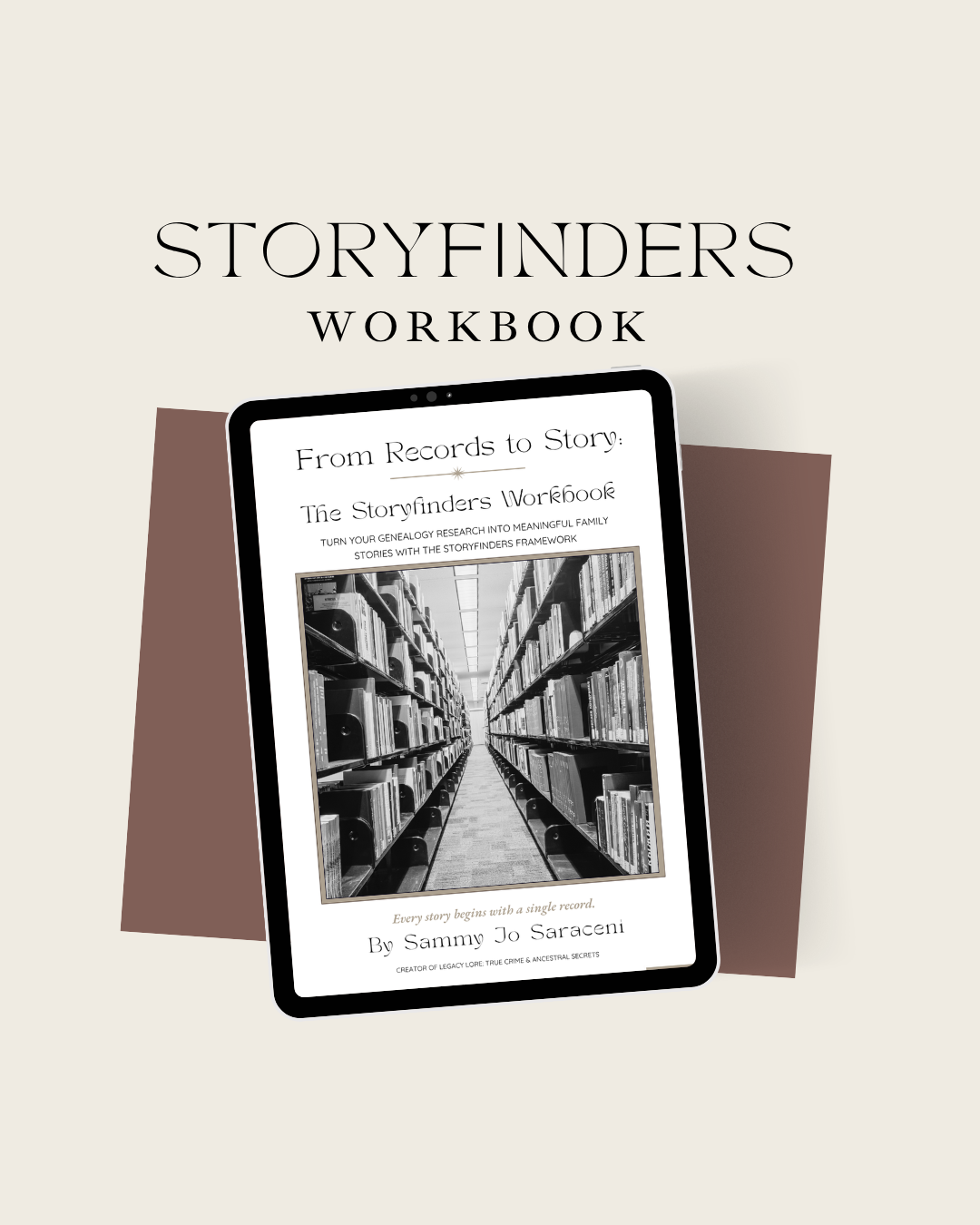
Turn your genealogy research into a meaningful family story.
You have the names. You have the dates. Maybe you even have boxes of records and years of research.
But how do you move from a collection of facts to a story that helps you understand the person behind them?
From Records to Story: The Storyfinders Workbook introduces you to the Storyfinders Framework, a five-step process designed to help you move from scattered records to a meaningful family narrative.
Inside, you'll learn how to:
Pick Your Person: choose an ancestor whose story you want to understand.
Build the Timeline: organize the records and events you already know.
Research the World Around Them: explore the historical context that gives those records meaning.
Define Your Story: identify the questions, experiences, and discoveries that shape the story you want to tell.
Write Your Story: begin turning your research into a narrative about the person behind the records.
Throughout the workbook, you'll follow the research process through the story of Eleanor Neale, an ancestor whose records led to questions about reputation, community, law, and an accusation of witchcraft in colonial Virginia.
You'll see how records became questions, how questions led to historical research, and how connecting the two changed the story.
Then you'll use the same process with your own ancestor.
Inside the workbook
A guided introduction to the Storyfinders Framework
Example worksheets using Eleanor Neale's research
A Pick Your Person worksheet
Personal timeline and historical-context worksheets
A historical research toolkit
Guided questions to help you define your story
Writing exercises to help you begin your first draft
Additional space to continue developing your story
You don't need a complete family tree or a finished research project to begin.
Start with one person. Start with what you know. Follow the questions that emerge.
Records tell us what happened. Context helps us understand why. And the stories we tell ensure our ancestors are remembered.
Storyfinders Episodes
History is full of stories waiting to be discovered. But behind every historical book is an author who has spent countless hours researching, questioning, and piecing together the past.
Storyfinders is a special interview series from Legacy Lore: True Crime + Ancestral Secrets featuring conversations with authors, historians, genealogists, and researchers whose work brings historical stories to life.
Through those conversations, we explore the inspiration behind their books, the research that shaped their work, the discoveries they made along the way, and the challenges of uncovering and interpreting the past.